Test the next idea against what works.
Keep it only if it wins.
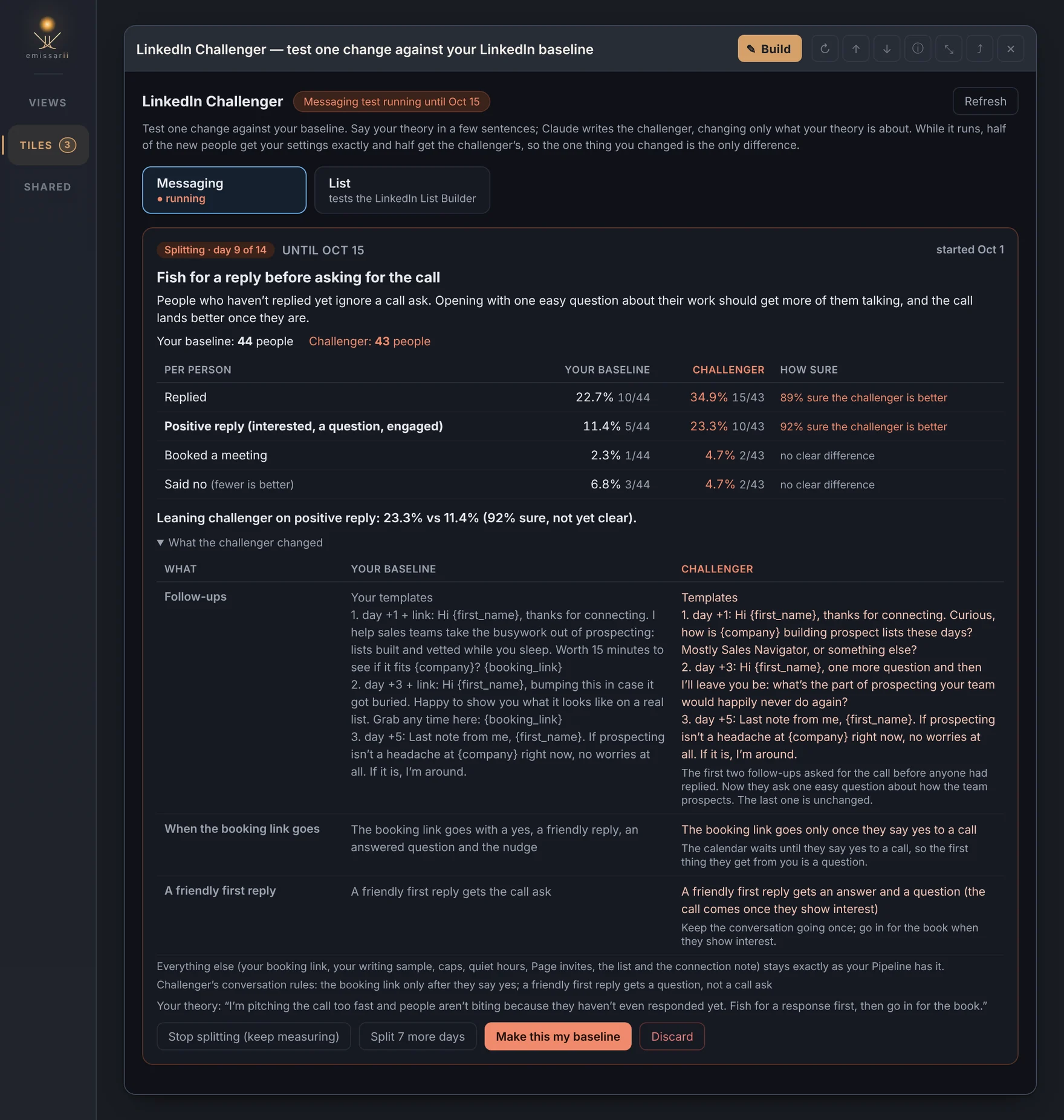
LinkedIn Challenger is out of the field and free in every Emissarii workspace. It brings the way software teams ship changes to your LinkedIn outreach: what works keeps running, a challenger takes half the new people, and it only becomes your setup if it beats what you have.
How software teams ship changes
Good engineering teams don't ship a change to everyone and hope. They put it behind a feature flag, send it a slice of real traffic, and compare it against what's already running before they roll it out. Machine-learning teams have a name for the pattern: champion/challenger. The model in production is the champion; a new model gets a share of live traffic as the challenger, and it replaces the champion only when it wins on real data.
It became the standard way to ship for good reasons:
- Real conditions, not guesses. Both versions run at the same time on the same kind of traffic, so a slow week lands on both and the difference is the change.
- A small blast radius. Half your new people keep getting what already works, and a losing idea is switched off when the test ends.
- Wins compound. Every winner becomes the new champion, and the next test starts from a better baseline.
- Data settles it. “Should we ask for the call sooner?” stops being a debate and becomes two numbers, with how sure the difference is.
Why sales teams rarely run it
Engineering has the tooling for this: flags, traffic splitting, dashboards that compare both sides. Sales never did. A real test means building a second campaign by hand: another sequence, a cloned list, some way to split people evenly, and a spreadsheet at the end to match every reply and meeting back to the side it came from. Lists are small, so a test has to run for weeks to mean anything, and by then three other things have changed. So most teams change everything at once, look at next week, and hope.
A feature flag for your outreach
LinkedIn Challenger is that tooling for LinkedIn. Describe the change in a few sentences. It builds the challenger from your live setup, changing only that, splits new people between it and your champion for as long as you say, and measures both sides the same way. If it wins, one click rolls it out as your setup. If it doesn't, switch it off: there is no second campaign to maintain or clean up, and nothing about your outreach changed.
How a test runs
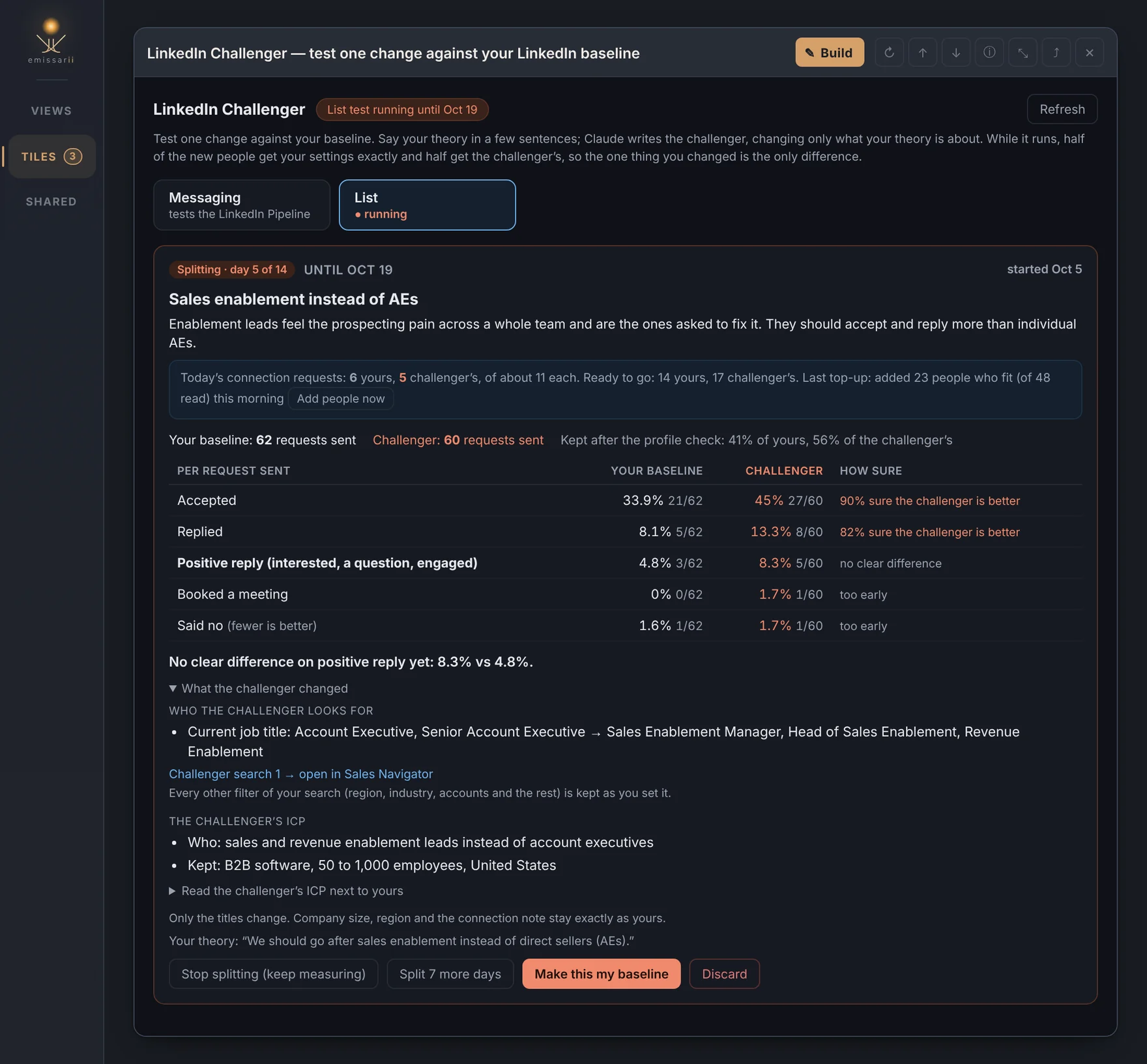
- Pick what to test. Messaging is what the LinkedIn Pipeline says after someone accepts: the follow-ups, the replies, when the booking link goes. List is who gets a connection request at all: the search and the ideal-customer profile behind it.
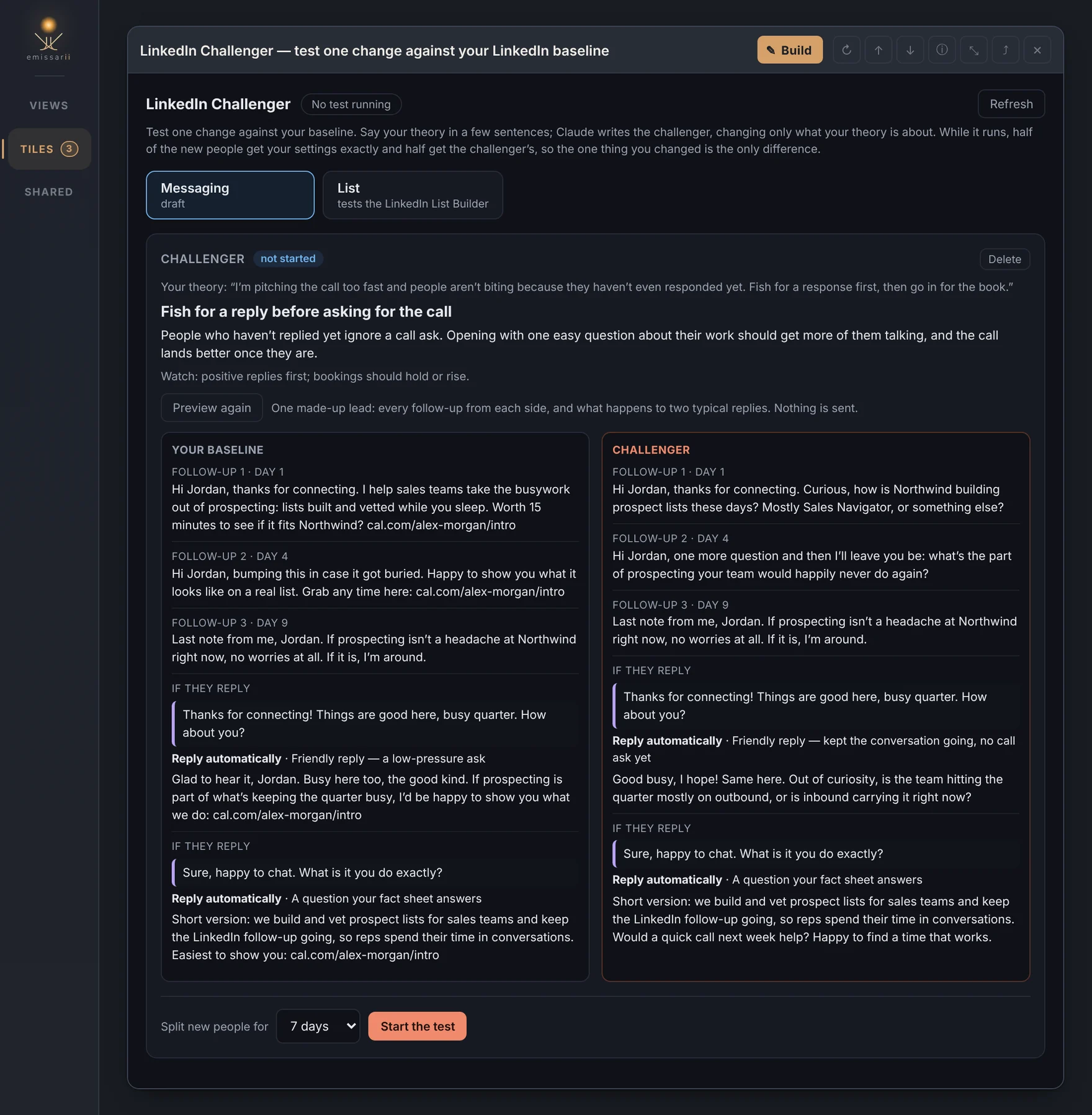
- Describe the change. A few sentences on what you'd do differently and why. The challenger is built from your current settings, and you see field by field exactly what differs. For messaging, a preview runs one made-up lead through both sides. For a list test, it edits a copy of your Sales Navigator search, keeps your region and every other filter, and shows you page 1 of who it finds. Nothing is sent.
- Run it. Pick 3 to 21 days. New people split in turns between champion and challenger: in a messaging test, both sides get the same list and the same connection note; in a list test, the same note and the same follow-ups, and nobody lands on both lists.
- Read it. Accepted, replied, positive replies, meetings booked and said no, for each side, with how sure the difference is.
- Keep it or drop it. Make this my baseline writes the change into your real settings. Discard ends it; in a messaging test, the challenger's people get your messages from their next one.
One change, measured honestly
A challenger is held to the change you described. A follow-up it wasn't asked to touch goes out word for word, punctuation and all, and your booking link, writing sample, caps and quiet hours never change. Only one test splits people at a time, so two experiments never blur into each other.
Small samples lie, so every result says how sure it is that a difference is real and not a lucky week. Until there are 20 people on each side, it says too early, whatever the numbers look like. When the days are up it stops splitting and keeps measuring, and the challenger's people keep its messages, so no conversation switches voice halfway. Plan on a couple of weeks for most tests; extending one is a click.
What you need
Challenger runs on top of the LinkedIn List Builder and the LinkedIn Pipeline, both free in every workspace, working in your own Chrome. A messaging test needs the Pipeline on; a list test also needs the search you paste into the List Builder. Like every app From the Field, it arrives empty: your settings, your leads and your results stay on your machine.
LinkedIn Challenger is free with every workspace, starting today. Install it next to the List Builder and Pipeline, and put your next idea up against what works.